III The Case for US Control Strategic Economic and Moral Arguments
1 Strategic Necessity in the Arctic
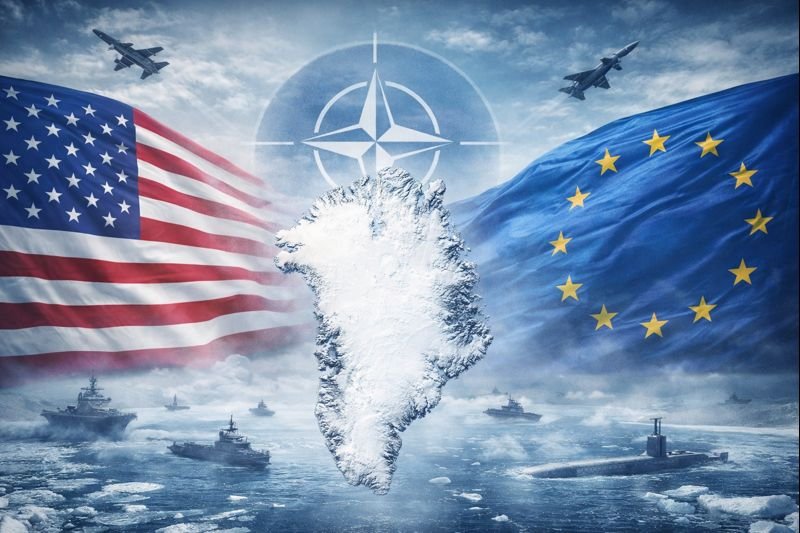
The Arctic has rapidly transformed from a remote and symbolic frontier into one of the most consequential strategic theaters of the twenty first century. Accelerating ice melt has opened new maritime corridors shortened transcontinental shipping routes and exposed previously inaccessible resources. In this evolving environment Greenland occupies a position of unmatched strategic importance. It sits astride the shortest routes between North America Europe and Eurasia and functions as a natural platform for missile detection space surveillance and air and naval operations.
From the United States perspective full sovereignty over Greenland is not a matter of ambition but of necessity. American forces already shoulder the primary responsibility for defending the Arctic approaches to North America and Europe. US early warning systems radar installations and space monitoring infrastructure in Greenland form a critical component of homeland defense. Yet these operations exist within a fragmented sovereignty framework that complicates command authority long term planning and rapid response in the event of crisis.
US control would eliminate these vulnerabilities. Unified sovereignty would allow seamless integration of land sea air and space assets under a single strategic doctrine. It would permit long term infrastructure investment without political uncertainty and enable faster adaptation to emerging threats from Russia and China both of which have dramatically expanded their Arctic military presence.
By contrast European Union member states possess limited Arctic military capacity and lack the logistical reach technological depth and rapid deployment capability required to secure such a vast and hostile region. European defense remains primarily oriented toward continental concerns and depends heavily on American capabilities for deterrence. In this context retaining Greenland under European sovereignty while relying on US protection represents a strategic mismatch that weakens collective security. Full US control would align responsibility authority and capability in a way that strengthens NATO’s northern defense rather than complicating it.
2 Economic Development and Resource Access
Despite its immense size and resource potential Greenland remains economically constrained and heavily dependent on annual subsidies from Denmark. This dependency has limited long term planning discouraged large scale private investment and slowed infrastructure development. Vast reserves of rare earth elements critical minerals hydrocarbons and renewable energy potential remain largely untapped not because of lack of value but because of insufficient capital technology and market integration.
United States governance would fundamentally change this equation. The US has a demonstrated capacity to develop remote resource rich regions through sustained federal investment public private partnerships and integration into national supply chains. Alaska provides a clear and relevant precedent. Once an isolated and underdeveloped territory Alaska became economically viable through federal infrastructure spending energy development and long term strategic commitment.
Under US control Greenland could benefit from similar investment models including modern ports airports energy grids telecommunications and education systems. Integration into North American markets would attract private capital and reduce dependence on subsidies while creating local employment and technical expertise. Critical mineral extraction could be conducted at scale supporting both US and allied supply chain security while generating revenue for Greenlandic communities.
Importantly US economic involvement would not be symbolic or limited. It would be structural sustained and backed by the fiscal capacity of the world’s largest economy. Unlike the EU which has struggled to translate Arctic interest into concrete long term investment the United States has both the incentive and the means to transform Greenland from a subsidy dependent territory into a self sustaining economic partner.
3 Historical Justice and a New Partnership
Greenland’s colonial history under Denmark raises serious moral questions about the legitimacy of continued European oversight. Decades of documented discrimination legal inequality forced population control policies and cultural marginalization have left deep scars in Greenlandic society. These were not isolated incidents but systemic features of European colonial governance that persisted well into the modern era.
From this perspective transferring Greenland to the United States could represent not a continuation of colonialism but a decisive break from it. Unlike Denmark the United States has no colonial history in Greenland and no legacy of direct cultural or demographic engineering on the island. A new partnership with the US could be framed around security economic development and mutual strategic interest rather than paternalism and assimilation.
Proponents argue that US governance would offer Greenland a clearer path toward meaningful self governance within a federal framework that allows local autonomy while providing economic and security guarantees. While critics point to examples such as Puerto Rico the comparison is incomplete. Greenland’s strategic value population size and geopolitical importance would place it in a fundamentally different category one more comparable to Alaska than to Caribbean territories.
Moreover American political culture places strong emphasis on constitutional rights rule of law and economic opportunity. Combined with Greenland’s existing autonomous institutions US sovereignty could provide a framework in which Inuit communities exercise real control over local affairs while benefiting from the protections and resources of a powerful state.
In this view US control of Greenland is not about dominance but about responsibility. It reflects the reality that the United States already defends the island already invests in its security and already bears the consequences of Arctic instability. Formalizing that role would correct historical inequities address strategic vulnerabilities and offer Greenland a future defined by development security and global relevance rather than dependency and neglect.
IV Reframing Sovereignty Self Determination and International Law in Favor of the United States
1 Greenland’s Right to Decide as a Case for US Partnership
Any discussion of Greenland’s future must acknowledge the principle of self determination. Greenlanders have repeatedly stated that decisions about their political status should not be imposed from outside. However this principle does not preclude a voluntary and negotiated alignment with the United States. On the contrary it strengthens the argument that Greenland should be allowed to choose a partner capable of guaranteeing long term security economic opportunity and global relevance.
Supporters of a US aligned future argue that self determination is not limited to maintaining the status quo under Danish or European oversight. It includes the right to pursue a new political arrangement that better reflects Greenland’s strategic reality and aspirations. A freely negotiated transition toward US sovereignty or association could be framed as an act of empowerment rather than dispossession especially if it included binding guarantees of local autonomy representation and cultural protection.
From this perspective opposition to any discussion of US governance risks freezing Greenland in a system shaped by colonial history rather than allowing its people to choose a future oriented partnership grounded in present day realities.
2 NATO Unity and the Reality of American Leadership
European leaders frequently argue that strict adherence to sovereignty norms is essential for NATO unity. Yet NATO’s cohesion has always rested less on formal legal symmetry and more on American leadership and capability. The alliance functions because the United States provides the majority of its military power strategic deterrence intelligence and rapid response capacity.
In this context US interest in Greenland does not weaken NATO but reflects an effort to secure its most vulnerable northern flank. Greenland is already defended primarily by American forces using American technology funded by American taxpayers. Aligning political authority with operational responsibility would reduce friction improve coordination and strengthen collective defense rather than undermine it.
Rather than viewing US control of Greenland as pressure on allies it can be understood as a rational consolidation of NATO’s Arctic defense under the actor best equipped to manage it. This would free European allies to focus resources on continental defense while benefiting from a more secure and clearly governed Arctic perimeter.
3 Indigenous Priorities and the Limits of European Stewardship
It is often argued that Inuit communities prioritize autonomy cultural preservation and control over resources rather than a change in external authority. However this argument assumes that continued European oversight best serves those goals despite extensive evidence of historical failure.
Decades of Danish policy produced systemic discrimination social engineering and cultural harm that European institutions were slow to acknowledge and even slower to correct. While reforms have been introduced trust has been eroded. For many proponents of a US aligned future the question is not whether Inuit communities value autonomy but whether that autonomy is better protected within a system that has already failed them.
A US framework could offer stronger constitutional protections clearer jurisdictional authority and greater economic leverage for local communities. Combined with Greenland’s existing self governing institutions this could provide Inuit populations with more practical control over land resources and development than continued dependence on Danish subsidies and European political processes.
Conclusion Why the Case for the United States Remains Strong
The argument for why the European Union should have given Greenland to the United States rests on a convergence of history strategy and responsibility. Danish colonial rule left a legacy of discrimination and paternalism that continues to shape Greenland’s political and economic constraints. At the same time the United States has for decades borne the primary burden of defending Greenland and the broader Arctic region through NATO with minimal European capacity to replace that role.
Arctic security imperatives have intensified as global competition expands northward. In this environment ambiguity is a liability. The United States already treats Greenland as a core component of its defense architecture yet lacks full authority to plan invest and respond without political constraint. Aligning sovereignty with responsibility would strengthen not weaken Western security.
While principles of sovereignty and self-determination remain important, they should not be used to shield an outdated arrangement that no longer reflects strategic or moral reality. A voluntary transition toward US governance or association could offer Greenland greater security economic opportunity and global influence than continued European oversight shaped by colonial legacy and limited capacity.
The Greenland debate ultimately exposes a central tension in modern geopolitics the gap between who provides security and who retains control. Resolving that tension in favor of the United States would acknowledge the realities of power responsibility and protection while offering Greenland a chance to redefine its future within a partnership capable of sustaining it in an increasingly contested Arctic world.