Texas Redistricting: How Democratic Strategies Are Eroding Voter Representation
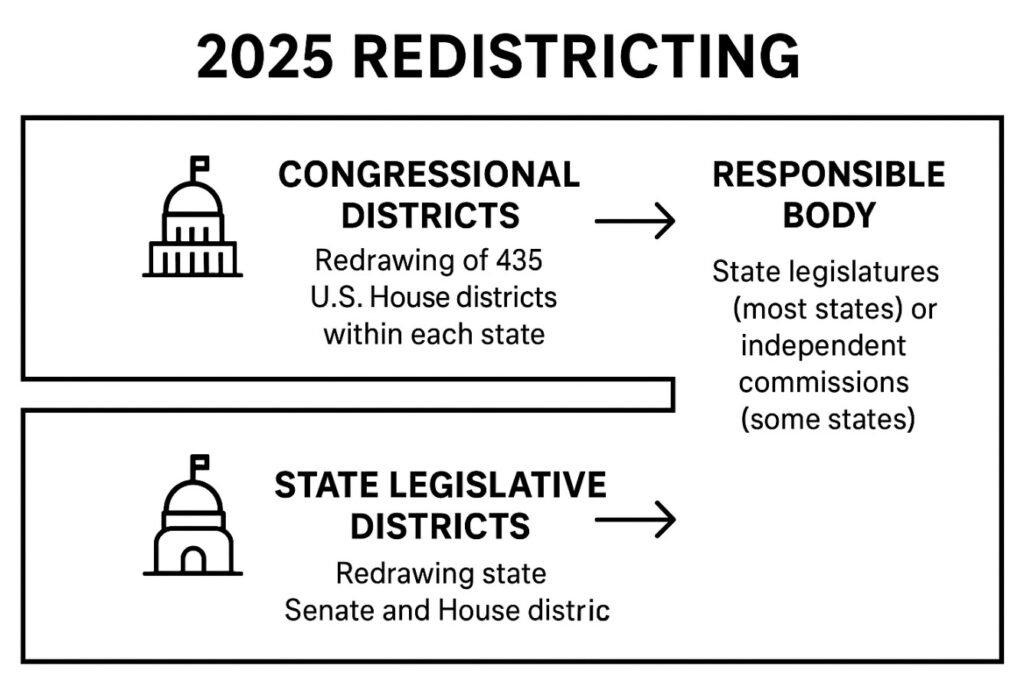
Every 10 years, the United States conducts a constitutionally mandated census. The point isn’t just to count people, it’s to ensure political power tracks where people actually live. After the census, states must redraw congressional and state-legislative districts so that each representative serves roughly the same number of constituents, the “one person, one vote” principle. When states duck or delay this decennial reset, citizens inherit maps that no longer reflect real population shifts. That means voters lose, and democratic legitimacy erodes.
In recent cycles, Democrats have often argued that partisan gerrymanders corrode public trust. But in too many cases, the party has leaned on mechanisms that effectively avoid or outsource the hard, accountable work of redistricting: shifting responsibility to commissions they can influence, punting to courts when it’s politically convenient, or refusing to accept decennial outcomes unless they deliver partisan advantage. This article makes the case that such avoidance undermines the very values Democrats claim to defend transparent, regular, representative map-drawing that reflects population change.
Below, we’ll unpack what decennial redistricting is supposed to do, how “avoidance” shows up in practice, why this pattern harms representation, and what reforms would align process with principle.
What Decennial Redistricting Is For?
At its core, decennial redistricting is democracy’s regularly scheduled maintenance. People move. Metro areas grow; rural populations shrink (or vice versa); communities of interest shift. The census captures these changes, and redistricting updates the electoral map accordingly. Most states assign map-drawing to their legislatures (subject to state and federal constraints), while a growing number use some form of independent or bipartisan commission. However it’s structured, the purpose is the same: translate population change into fair representation, on a predictable 10-year timetable.
What Should Happen: A Decennial Reset for Democratic Representation
Texas like any other state is supposed to redraw its state and congressional districts based on updated census data, it’s a transparent process, Texas lawmakers, including both parties are supposed to update district boundaries, aligning representation with where people live. This isn’t optional, it’s an essential exercise to ensure Texans are fairly represented as populations shift. This process ensures that fast-growing areas like Austin, Houston, and the Rio Grande Valley get their fair share of congressional and legislative seats, and that declining areas don’t retain outsized influence. If population growth isn’t reflected, urban Texans will get underrepresented, and rural or stagnant areas will get overrepresented. This will distort vote equality and undermines democratic accountability. Democratic strategies around redistricting – particularly avoidance, delay, and conditional acceptance of commissions are eroding representation in this state.
Why Dodging the Decennial Process Damages Democracy
A) It Breaks the Population–Representation Link
If maps aren’t refreshed promptly after the census—or are constantly re-opened mid-decade—districts drift out of alignment with real communities. Growing areas may be under-represented for years; shrinking areas over-represented. The whole point of the decennial reset is to keep the system honest. Avoiding that reset, or turning it into a rolling partisan negotiation, severs the link between people and power.
B) It Replaces Accountability with Process Games
Commissions can insulate against abuses, but they can also become political armor—especially when politicians celebrate them publicly and undercut them privately. Likewise, letting courts draw maps may be legally sound but democratically thin: voters can’t “vote out” a special master. When elected leaders neither pass maps nor stand up and defend them, citizens can’t hold anyone meaningfully accountable.
C) It Teaches the Wrong Civic Lesson
Voters notice when a party champions independent, census-anchored maps in states where it helps them and then discards that principle elsewhere. Today’s California debate, framed as a necessary response to Texas, will be heard nationwide as “we’ll follow good-government rules when convenient.” That message undermines faith in reforms that took years to build.
D) It Invites Endless, Nationalized Map Wars
Once one side conditions its process on what the other side does, redistricting becomes national trench warfare. The result is less stability, more litigation, and a never-ending sense that maps are temporary, tactical, and subject to change whenever power changes hands. That instability depresses participation, confuses communities about their districts, and turns what should be a boring, decennial chore into a running constitutional crisis.
A Better Way: Principles That Serve Voters First
If Democrats truly want to protect democracy, they should adopt reforms that make it harder to avoid decennial accountability and easier for voters to see and judge the process.
1. Commit publicly to a decennial calendar, with narrow, transparent exceptions.
Make the default that maps are drawn once per decade, promptly after census data arrives. Allow mid-decade changes only for court-ordered Voting Rights Act remedies or truly extraordinary circumstances, with supermajority triggers and public justification. Enshrine the commitment in state law. (Multiple nonpartisan resources—the NCSL among them—underscore that the decennial cadence is the bedrock.)
2. If you use commissions, make them truly independent, and stick to them.
Independence should be more than branding. Commissioner selection must minimize partisan capture; deliberations should be transparent; and timelines should be binding so maps are done on time. Most importantly, politicians should renounce “escape hatches” that let them reject commission outcomes just because they can. You can’t defend commissions as democracy-enhancing and then bypass them when the math turns inconvenient.
3. Restore political accountability for final maps.
Even with commissions, require an on-record legislative vote to accept maps unless the commission’s plan automatically takes effect. If lawmakers amend or replace maps, require supermajorities and detailed public findings tied to specific legal criteria (equal population, minority representation, compactness, continuity, and respect for communities of interest). Force politicians to own their changes—then face voters.
4. Stop the conditional ethics.
If Democrats believe partisan gerrymanders are wrong, that position can’t depend on what Texas or any other state does next. Otherwise, “defending democracy” becomes a slogan, not a standard. California’s floated contingency plan—ditching its celebrated commission only if Texas acts—epitomizes the problem. A principled party keeps its own house in order first and uses litigation, federal standards, or interstate compacts to address other states, not tit-for-tat redraws.
5. Invest in durable national guardrails.
While Congress is gridlocked, parties that claim to defend democracy should push for baseline federal standards on timing, transparency, data use, and anti-entrenchment rules, leaving states room to implement but removing the incentive to game the calendar. Short of new federal law, states can adopt uniform triggers that lock in decennial timing and sharply limit mid-cycle tinkering.
The Democratic (Small-d) Case for Doing the Work
Decennial redistricting is not glamorous. It is meticulous, technical, and politically risky. But if the goal is real representation, there’s no substitute for doing the work on time, in public, and under rules you’re willing to live under whether you’re up or down in the polls.
When Democrats defer to commissions only to override them, or welcome courts to draw lines rather than building consensus, or threaten mid-cycle redraws when convenient, they communicate that process is a weapon, not a covenant. The immediate rewards of such avoidance are obvious: you buy time, you dodge tough votes, you gain leverage. The long-term costs are devastating: cynicism deepens, turnout suffers, and citizens conclude that maps are just another partisan stunt.
If Democrats want to prove they’re protecting democracy, not merely talking about it, they can start here:
1) Honor the decennial clock. Finish maps promptly after the census. No excuses.
2) Design commissions you’ll accept even when they hurt you. If you won’t, don’t pretend they’re independent.
3) Reserve courts for wrongs, not gridlock. Don’t make judges your mapmakers by default.
4) Renounce conditional redistricting. Stop treating principles as switchable depending on another state’s moves.

The Real Impact on Ordinary Texans
1. Representation gaps grow in booming areas.
Imagine a fast-growing suburb near Austin that’s added 200,000 people since the last census—yet it still shares a representative with shrinking rural counties. That undercuts the political power of those citizens, making their voices weaker.
2. Minority voice dilution persists.
Many Democratic-led districts in Texas are majority-minority. Avoiding decennial updates can dilute those communities by slicing them across districts, reducing their influence and weakening protections under the Voting Rights Act.
3. Voter confusion and apathy increase.
When district lines change mid-decade—especially unpredictably—Texans get confused about who represents them, where to vote, and whether it matters. That drags down turnout and civic engagement.
4. Trust in elections erodes.
When citizens see political leaders playing games with maps—not doing their jobs on time, rejecting good-government reforms when they’re inconvenient—they lose faith in the fairness of elections. That cynicism hurts every candidate, especially down-ballot races that shape communities directly.
How Resistance to Redistricting Is Affecting Representation in Texas

Featured Image Credit:
Photo by Ted Eytan, used under license: Deed – Attribution-ShareAlike 4.0 International – Creative Commons
1. Mid-Decade Redistricting Push
2. Walkouts and Quorum-Breaking
-
To block the proposal, House Democrats left the state, preventing the legislative body from achieving a quorum necessary to pass the map.
-
In response, Governor Abbott threatened arrest, extradition, and removal from office—but these moves were largely symbolic.
3. Democratic Response Magnifies Tensions
4. Beyond Texas: National Ramifications
5. Democracy at Risk
-
Critics argue this tit-for-tat approach erodes democratic norms. Even if one side claims moral high ground, the strategy risks reinforcing partisan gridlock over fair representation.
-
Studies show hyper-partisan redistricting lowers public confidence in election integrity.
Why Democrats Should Put Texans First, Not Politics
1. Commit to timely redistricting
Texans deserve updated, fair district lines promptly after the census—no stalling or strategic recalibration. That ensures growing areas get deserved representation, regardless of short-term partisan advantage.
2. Stick to reforms, even when they don’t deliver a partisan win
If you support independent redistricting commissions as a principle, stand by them even when the maps aren’t favorable. That restores trust and shows voters the process, not party dominance, matters.
3. Avoid mid-decade redraws unless legally required
Respect the decennial schedule. Communities need stability in representation; pivoting mid-cycle disrupts that, especially when politically motivated.
4. Let voters hold you accountable
If Democrats won’t draw maps fairly and on time, voters can’t reward or punish them at the ballot box. Own your part of the process or resign yourself to delegating it to courts or special masters, then watch accountability vanish.
A Texas Centered Case
Consider Texas’s explosive population growth tens of millions added in the last decade, with major shifts toward urban centers. Under a decennial update, seats would shift accordingly: more representation for Austin-area subdistricts, for example, reflecting booming Hispanic and Asian communities.
But if Democrats refuse to pass maps on time or reject commissions when they can’t muster a partisan advantage, these growing communities get left behind. Either the maps stay frozen mid-growth, or court-drawn maps fail to reflect neighborhood cohesion. If Republicans benefit because Democratic districts shrink or are diluted, that’s an outcome made possible by Democratic avoidance that hurts Texas voters first and foremost.
In Conclusion: Make the Map Serve Texans
1) If Democrats genuinely care about “serving the electorate” in Texas, they must prove it not through slogans but by action:
2) Draw maps on time.
3) Honor independent processes and stop creating an environment of fear around this democratic exercise.
4) Ensure every Texan, no matter their zip code gets fair and accurate representation.
While Texas Democrats claim that they want to halt anti-democratic maneuvers, their strategic walkouts and protest tactics are intentionally driving the same partisan logic they claim to oppose. At worst, this could normalize redistricting as a perpetual political weapon, further alienating voters and weakening faith in democratic institutions.
Every 10 years, the map resets. It’s not just a political convenience – it’s the democratic duty. Texans deserve leaders who treat it that way.