
Featured Image Credit:
Photo by Gage Skidmore, used under license: Deed – Attribution-ShareAlike 2.0 Generic – Creative Commons
India’s trade policy is one of the most protectionist among major global economies. For decades, India has leveraged American openness to expand its own industries, while systematically denying U.S. exporters fair access to Indian markets. The recent escalation in India U.S. Trade Tariffs reflects a growing frustration in Washington over India’s persistent trade protectionism and favoritism toward adversarial regimes. Through sky-high tariffs, obscure non-tariff barriers (NTBs), and deliberate regulatory obstruction, India has created an economic moat around its domestic sectors—hurting American businesses and, ironically, its own consumers. Among the few global leaders who vocally called out this double standard was former U.S. President Donald Trump. His frustration with India’s tariffs wasn’t a passing quip; it was rooted in decades of asymmetric trade policies that harmed the United States.
What’s more, recent geopolitical developments add weight to the U.S. position. India’s deepening economic alignment with Russia—especially its record-breaking purchases of Russian oil—is indirectly helping finance Russia’s brutal war in Ukraine. Against this backdrop, the United States’ imposition of 25% tariffs and penalties on certain Indian imports is not just a matter of trade fairness, but of foreign policy integrity. America is right to reassert pressure on India, especially as New Delhi continues to exploit U.S. markets while cozying up to Moscow.
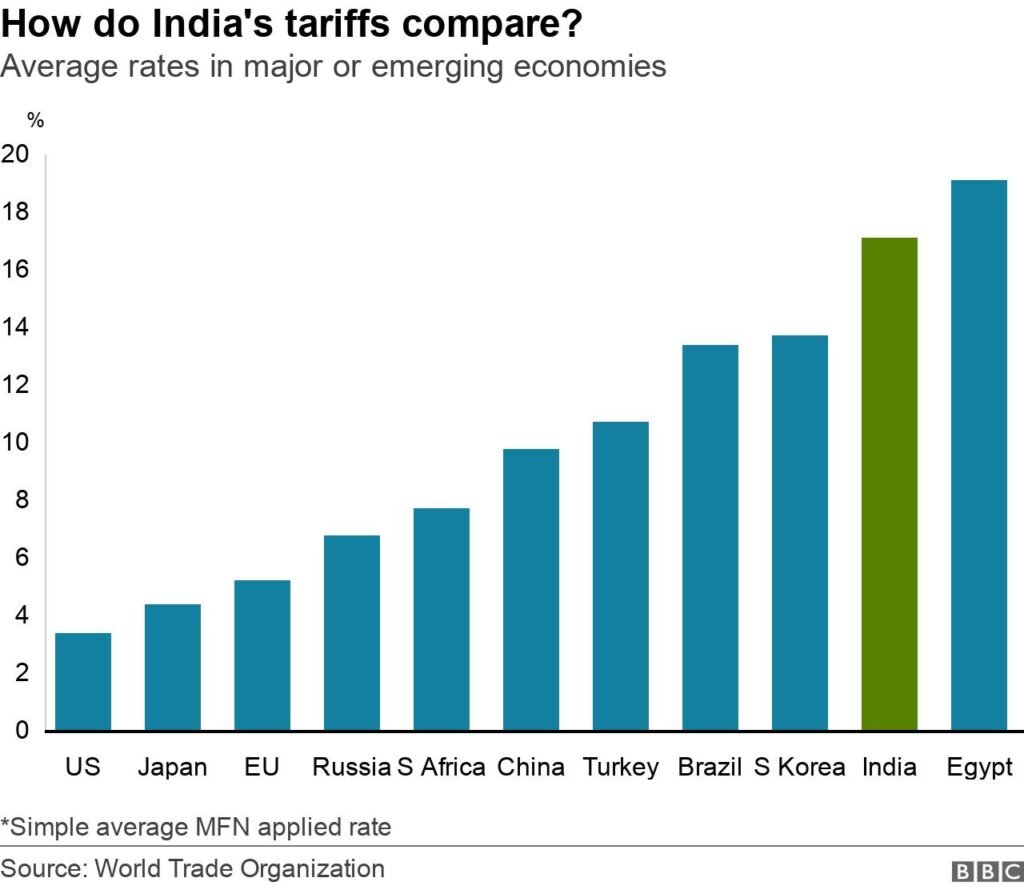
India’s tariff system is notoriously complex and designed to discourage imports. While the average U.S. tariff rate hovers around 3.4%, India’s average rate is over 13%, among the highest in the world. But in many categories relevant to American exporters, tariffs are far higher—often arbitrarily so. For example, India once imposed a 100% tariff on Harley-Davidson motorcycles. Tariffs on American-made almonds, apples, and walnuts—major agricultural exports—have reached as high as 70%. U.S. medical devices like stents and implants are not only taxed heavily, but subject to price controls and distribution restrictions that prevent fair market access.
Beyond these direct taxes, India employs non-tariff barriers (NTBs) as a powerful and insidious form of protectionism. These include excessive licensing requirements, bureaucratic delays, duplicative testing mandates, and deliberately vague product standards that disproportionately affect foreign firms. American exporters frequently report unjustified delays at Indian ports, shifting import rules, and inconsistent treatment across Indian states. For example, American dairy companies were long excluded based on unscientific claims that U.S. cows were not “vegetarian-fed.” Electronics and e-commerce platforms like Amazon and Apple face sudden data localization requirements, investment caps, and price manipulation policies that make long-term investment nearly impossible. These aren’t safety regulations—they’re tactical tools of trade suppression.
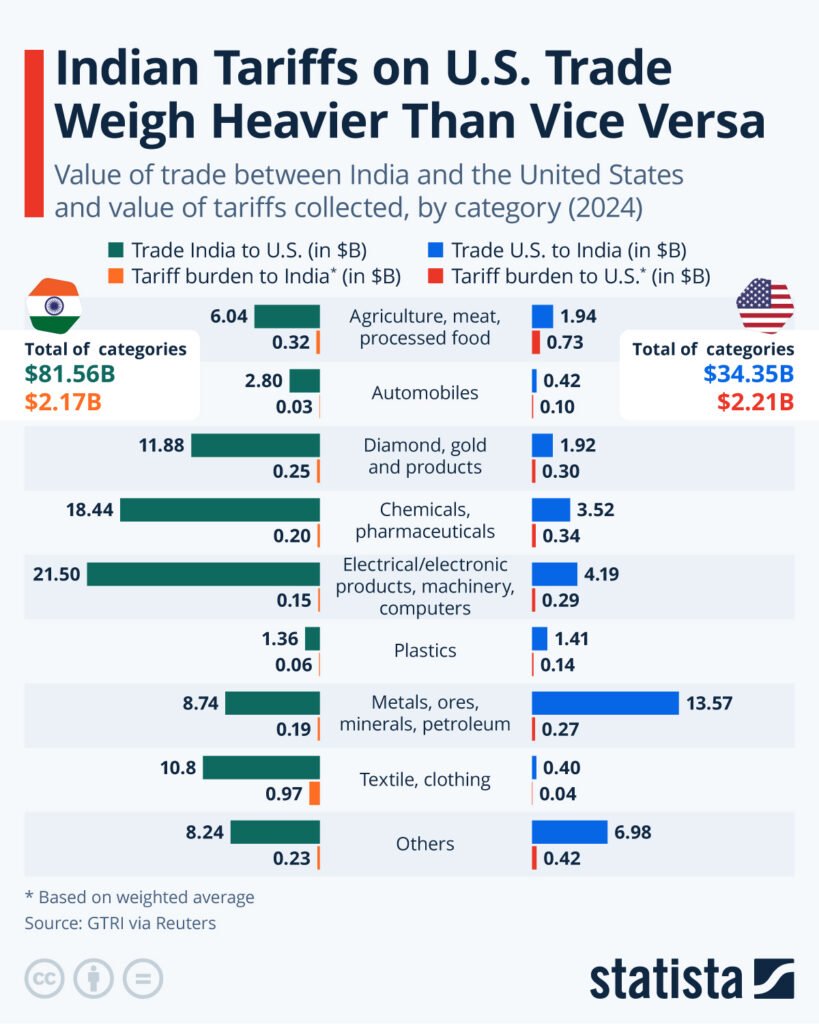
The United States, in contrast, has long operated under a principle of openness. Even when India was a far poorer country, it enjoyed access to the U.S. market under favorable conditions—particularly through the Generalized System of Preferences (GSP), which allowed billions in Indian goods to enter duty-free. While India benefited from this generosity, it never reciprocated. For example, U.S. firms faced rigid restrictions in India’s insurance, retail, and digital sectors, even as Indian companies like Infosys, Tata, and Wipro reaped billions in contracts across the U.S. economy.
Trump’s frustration—culminating in the removal of India from the GSP program in 2019—was entirely warranted. The U.S. was merely asking for reciprocity: equal access to Indian markets for American products. But New Delhi refused even modest reforms. It’s no surprise, then, that the U.S. began considering higher retaliatory tariffs, including the 25% duties now being imposed on certain Indian products.
Critics of these tariffs fail to understand their context. These are not arbitrary penalties—they are corrections to years of abuse. They serve two purposes: first, to rebalance an unfair trade relationship; and second, to send a clear message that continued exploitation of U.S. openness will come at a cost. America is not obligated to act as an economic doormat for a country that refuses to liberalize, especially when that country is also working against broader U.S. interests on the global stage.
Indeed, India’s economic policies are no longer just anti-competitive—they are geopolitically damaging. Since the start of Russia’s full-scale invasion of Ukraine in 2022, India has massively increased its imports of Russian oil, making itself one of the top buyers of Kremlin crude. While the West has imposed sanctions to isolate and weaken Moscow, India has stepped in as a discount buyer, purchasing oil at below-market rates and refining it into petroleum products for resale.
This practice has become so extensive that Indian ports have become key laundering points for Russian oil entering international markets. By continuing this trade, India is effectively sending billions of dollars to Russia, helping prop up Vladimir Putin’s war machine. This is not speculation—it’s confirmed by trade data and publicly available records. Despite claiming neutrality, India is financially aiding one side in the world’s largest war since World War II.
Such behavior is unconscionable from a country that claims to be a democratic partner of the West. India can’t have it both ways: benefiting from American trade, technology, defense cooperation, and visa systems—while simultaneously bankrolling the enemies of the free world. The U.S. taxpayer funds Indian space collaboration, gives India access to U.S. university systems, and invests billions in defense partnerships. Yet India turns around and buys discounted crude from a regime that bombs hospitals and abducts children in Ukraine. It is, frankly, a betrayal of values.
This geopolitical duplicity adds urgency to U.S. trade action. Tariffs are not just about rebalancing trade—they are a tool of foreign policy. They remind partners that access to the U.S. market is a privilege, not a right. When a country refuses to uphold international norms, aids an aggressor like Russia, and simultaneously suppresses fair trade with the U.S., penalties are not only justified—they are essential.
The Indian government tries to frame its economic nationalism as “self-reliance” or “Atmanirbhar Bharat.” But this rhetoric masks a deeply inward-looking, restrictive trade posture that stifles innovation, competition, and consumer choice. Indian consumers, far from benefiting from protectionism, are among its biggest victims. They pay more for electronics, food, automobiles, and healthcare—all because the government blocks cheaper or better imports under the pretense of economic patriotism.
A stark example is the deliberate exclusion of Chinese electric vehicles (EVs) from the Indian market. China has made extraordinary technological advances in this sector. Firms like BYD, XPeng, and Nio are producing EVs with superior battery life, faster charging times, and integrated AI systems that are far ahead of Indian alternatives. In an open market, these vehicles would be available to Indian consumers at competitive prices—especially helpful in a country choking on air pollution and desperate for clean transport.
But instead, India imposes 100% import duties on fully built EVs and additional non-tariff barriers such as opaque certification requirements and arbitrary investment restrictions. Chinese firm BYD, which dominates in global EV innovation, has faced repeated rejections and stonewalling from Indian regulators—largely due to geopolitical tensions rather than consumer or environmental concerns. The net effect? Indian consumers are denied access to cutting-edge green technology while being forced to buy more expensive and inferior domestic alternatives.
This form of “protectionism as nationalism” is both economically regressive and environmentally damaging. The supposed goal of fostering domestic champions results in stagnation, lack of competition, and inflated prices. While the world accelerates toward an electric, green economy, India falls behind—held hostage by its own restrictive policies.
Similar damage occurs in other sectors. In healthcare, for instance, India’s price caps on imported U.S. medical devices have discouraged innovation and kept high-quality tools out of Indian hospitals. In technology, foreign platforms face algorithmic suppression and predatory regulation. In agriculture, U.S. exports are kneecapped by sudden rule changes and sanitary barriers that appear designed to block—not regulate—trade.
Worse still, India’s actions send a chilling message to global investors: that success in the Indian market is not based on product quality, price, or innovation—but on your ability to navigate protectionist bureaucracy, appease nationalist politicians, or cut deals with state-owned enterprises. This fundamentally undermines the idea of free markets and discourages long-term investment.
All of this validates the Trump administration’s harder line on India and should encourage the current U.S. administration to continue holding the line. Tariffs are not about punishment—they are leverage. And in India’s case, they are one of the few tools available to push for long-overdue reforms. India’s refusal to open its markets, combined with its morally indefensible alignment with Russia, leaves the U.S. with no choice but to escalate pressure.
India cannot continue to enjoy unrestricted access to the American consumer while shielding its own markets and subsidizing authoritarian regimes. Fair trade must be two-way. Economic cooperation must align with geopolitical values. If India wants to be treated as a trusted democratic partner, it must start acting like one—on trade, on transparency, and on the world stage.
Until that happens, tariffs and penalties are not only appropriate—they are essential for justice, economic fairness, and global stability.